
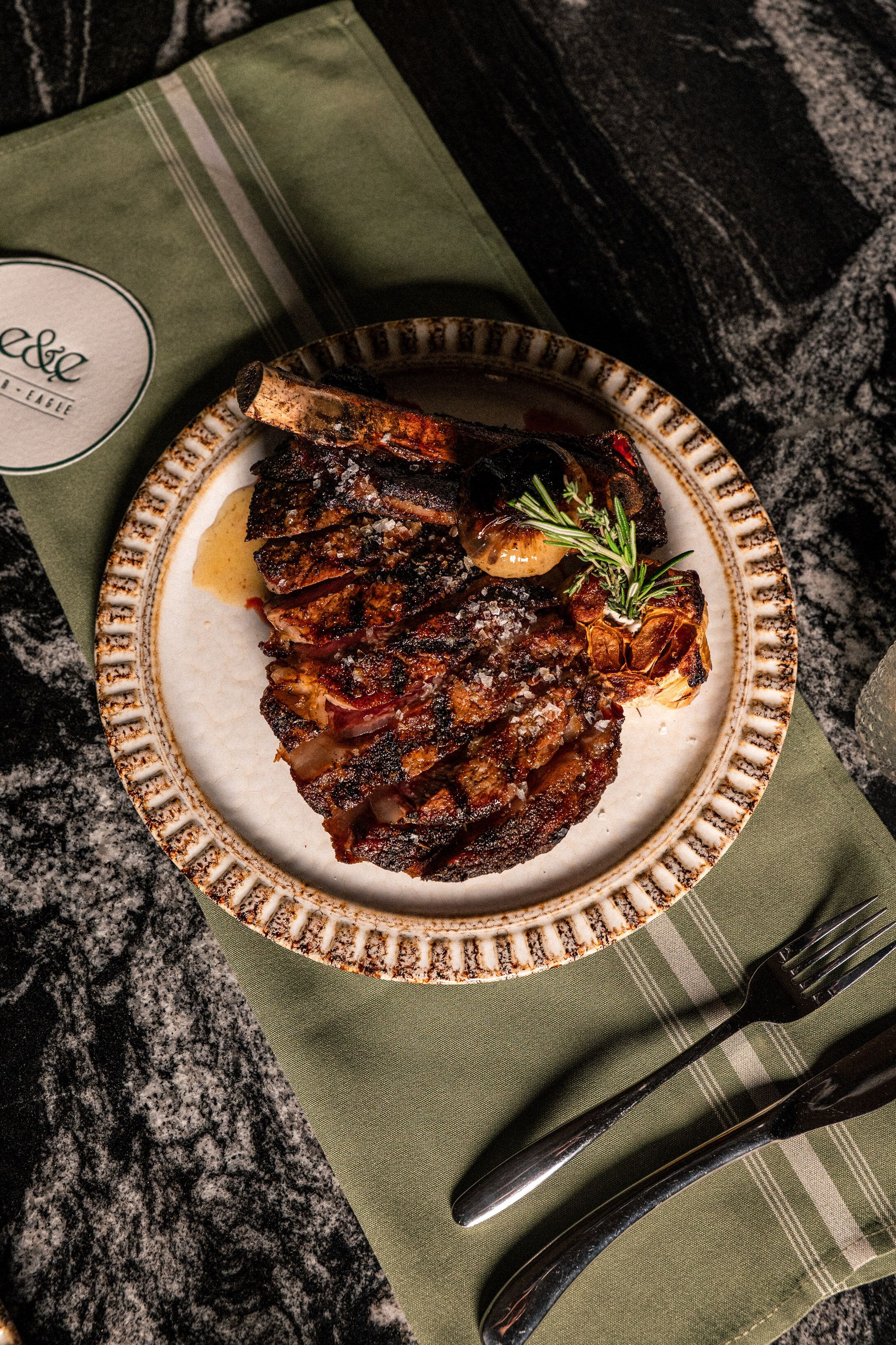
Order the porterhouse to share and taste two cuts in one, and the cowboy ribeye for the richest, most marbled bite from a single muscle. A porterhouse joins a New York strip and a filet mignon on a T-shaped bone; a cowboy ribeye is a thick bone-in ribeye with its fatty cap. At 36 oz against 24 oz, the porterhouse is the bigger centerpiece for a table.
Both steaks sit at the top of our board, and both are Pat LaFrieda prime cuts dry-aged for 60 days. That makes this a fair fight: same supplier, same aging, same open-flame grill. The difference is the cut itself.
What is a porterhouse steak?
A porterhouse is cut from the rear of the short loin. A T-shaped bone divides it into two steaks:
- The New York strip side: firmer, beefy and well structured.
- The filet mignon side: the tenderloin, the most tender muscle on the animal, mild and buttery.
By USDA standards, the tenderloin portion of a porterhouse must be at least about 1.25 inches wide. That is what separates it from a T-bone, which has a smaller piece of filet.
What is a cowboy ribeye?
A cowboy ribeye is a thick, bone-in ribeye cut from the rib section, with a short, trimmed rib bone. It is one continuous muscle with heavy marbling, plus the ribeye cap (the spinalis), the curved outer muscle many steak lovers consider the best bite on the animal.
Porterhouse vs cowboy ribeye: side by side
Where it comes from
- Pat LaFrieda Prime Porterhouse
- Rear of the short loin
- Pat LaFrieda Prime Cowboy Ribeye
- Rib section
What is on the plate
- Pat LaFrieda Prime Porterhouse
- Two cuts: New York strip and filet mignon
- Pat LaFrieda Prime Cowboy Ribeye
- One cut: ribeye with its cap
Bone
- Pat LaFrieda Prime Porterhouse
- T-shaped
- Pat LaFrieda Prime Cowboy Ribeye
- A single rib bone
Marbling
- Pat LaFrieda Prime Porterhouse
- Moderate on the strip, lean on the filet
- Pat LaFrieda Prime Cowboy Ribeye
- Heavy throughout
Texture
- Pat LaFrieda Prime Porterhouse
- Two textures: firm strip, very tender filet
- Pat LaFrieda Prime Cowboy Ribeye
- Consistent, juicy and tender
Flavor
- Pat LaFrieda Prime Porterhouse
- Beefy strip, mild filet
- Pat LaFrieda Prime Cowboy Ribeye
- The richest, beefiest of the two
Weight on our menu
- Pat LaFrieda Prime Porterhouse
- 36 oz
- Pat LaFrieda Prime Cowboy Ribeye
- 24 oz
Dry-aging on our menu
- Pat LaFrieda Prime Porterhouse
- 60 days
- Pat LaFrieda Prime Cowboy Ribeye
- 60 days
Menu price at the time of writing
- Pat LaFrieda Prime Porterhouse
- $165
- Pat LaFrieda Prime Cowboy Ribeye
- $119
Price per ounce (bone in)
- Pat LaFrieda Prime Porterhouse
- About $4.58
- Pat LaFrieda Prime Cowboy Ribeye
- About $4.96
Prices come from the current dinner menu; menus change seasonally.
What 60 days of dry-aging does to each cut
Dry-aging concentrates flavor as moisture leaves the beef, and natural enzymes make it more tender. At 60 days, both steaks carry a deep, nutty, savory character. The cut changes how that shows up:
- Cowboy ribeye: the fat carries the aged flavor through every bite, so 60 days reads bold and rich from edge to center.
- Porterhouse: the strip side shows the aged character most, while the filet side stays milder. One steak gives you two intensities.
Both are bone-in cuts, the kind that handle long aging best: the bone and fat cap protect the meat while it ages. For the full picture, read what dry-aging does to a steak.
How many people each steak feeds
Weights on a steakhouse menu include the bone, so the amount of meat on the plate is lower than the number suggests. As a guide for ordering:
| Your table | What to order |
|---|---|
| One hearty eater | The 24 oz cowboy ribeye |
| Two people sharing | The 36 oz porterhouse, or the cowboy ribeye with a pasta and two sides |
| Three people | The porterhouse with a pasta, a seafood starter and sides |
| Four people | The porterhouse and the cowboy ribeye together, to taste both |
| A ribeye lover and a filet lover | The porterhouse: the filet side for one, the strip for the other |
Your server can talk you through portions for your table on the night.
Which steak should you order? A quick decision guide
- You want the most flavor per bite: the cowboy ribeye.
- You want the most tender bite: the porterhouse, filet side first.
- You cannot decide between a strip and a filet: the porterhouse gives you both.
- You are celebrating and want a centerpiece: the porterhouse is the larger shared cut.
- You like a crisp, rendered edge: the cowboy ribeye’s fat cap chars beautifully over open flame.
- You prefer a leaner steak: the porterhouse, or the 8 oz prime filet mignon on its own.
Cowboy ribeye vs tomahawk
Both are bone-in ribeyes from the same section. The difference is the bone: a tomahawk keeps a long, frenched rib bone, while a cowboy ribeye’s bone is cut short. On our menu, the Pat LaFrieda prime tomahawk is 42 oz and dry-aged 45 days, while the cowboy ribeye is 24 oz at 60 days.
Bone
- Cowboy ribeye
- Short
- Tomahawk
- Long, frenched
Weight on our menu
- Cowboy ribeye
- 24 oz
- Tomahawk
- 42 oz
Dry-aging
- Cowboy ribeye
- 60 days
- Tomahawk
- 45 days
Best for
- Cowboy ribeye
- One or two guests who want full dry-aged intensity
- Tomahawk
- A table sharing a showpiece cut
Sauces, sides and a bottle to match
Every steak is grilled over open flame, with sauces on the side so the beef leads:
- With the porterhouse: béarnaise suits the filet side; bordelaise suits the strip.
- With the cowboy ribeye: caper salsa verde or red pepper steak sauce cuts through the richness; black truffle emulsion leans into it.
- Sides for either: pomme puree, roasted wild mushrooms, or creamed broccoli rabe with crispy guanciale.
For wine, a structured Italian red such as Brunello or Barolo, or a Napa cabernet, stands up to 60-day beef. Browse the cellar before you arrive, or ask for a pairing at the table.
Frequently asked questions
Is the porterhouse the king of steaks?
It is often called that because it gives you two prized cuts, the strip and the filet, on one bone. Diners who care most about marbling and flavor often prefer a ribeye.
Are porterhouse and T-bone the same cut?
They come from the same part of the short loin and share the T-shaped bone. A porterhouse is cut from the rear end, where the filet is larger; by USDA standards its tenderloin must be at least about 1.25 inches wide.
Is a cowboy ribeye better than a regular ribeye?
A cowboy ribeye is a ribeye left on the bone and cut thick. The bone helps it cook evenly and holds up well to long dry-aging, which is why ours is aged 60 days.
Which is more tender, porterhouse or ribeye?
The filet side of a porterhouse is the most tender meat on either steak. The ribeye is tender throughout thanks to its marbling, with a little more chew and much more fat.
How should I order a 60-day steak cooked?
Medium-rare is a common recommendation for dry-aged steak, since cooking well past medium mutes the aged flavor.
Taste both at our Eatontown steakhouse
The easiest way to settle porterhouse vs ribeye is to order both for the table. Our kitchen, led by Executive Chef Dennis Mathews and chef and partner Ryan DePersio, grills every dry-aged cut over open flame. Meet the team, then reserve a table up to four weeks ahead.